
01
Keep operating, or gain time to shut down?
Start by naming the essential service: recording video, keeping the local network available or shutting equipment down cleanly. These objectives may require different runtimes and interfaces. State who decides, what must remain available and what can stop; do not automatically back up every device merely because it shares a rack.
Watts describe active power; VA describe apparent power. Selection must respect both UPS ratings without applying a universal conversion factor to every device. Runtime is a separate question, depending notably on load and battery configuration. Request a manufacturer curve matching the proposed configuration.
02
Connect backup power to a service, not just a socket.
This path describes roles to verify with the installation professional. It gives no electrical wiring instructions.
01 · Site supply
Have a competent professional verify input, installation and protective-device compatibility. Document room and maintenance constraints.
02 · UPS and batteries
Specify the reference, W/VA limits, battery configuration and runtime documentation. Identify every additional module explicitly in the offer.
03 · Outputs and loads
Map each device to its intended output and confirm backup support. Inventory connectors, cords and distribution without assuming inclusion.
04 · Monitoring and shutdown
For automatic shutdown, confirm the interface, software, target system and permissions. A communication port does not prove that the scenario is configured.
05 · Tests and follow-up
Agree a controlled test, criteria and owners. Retain configuration, results and manufacturer instructions; do not improvise an outage during operation.
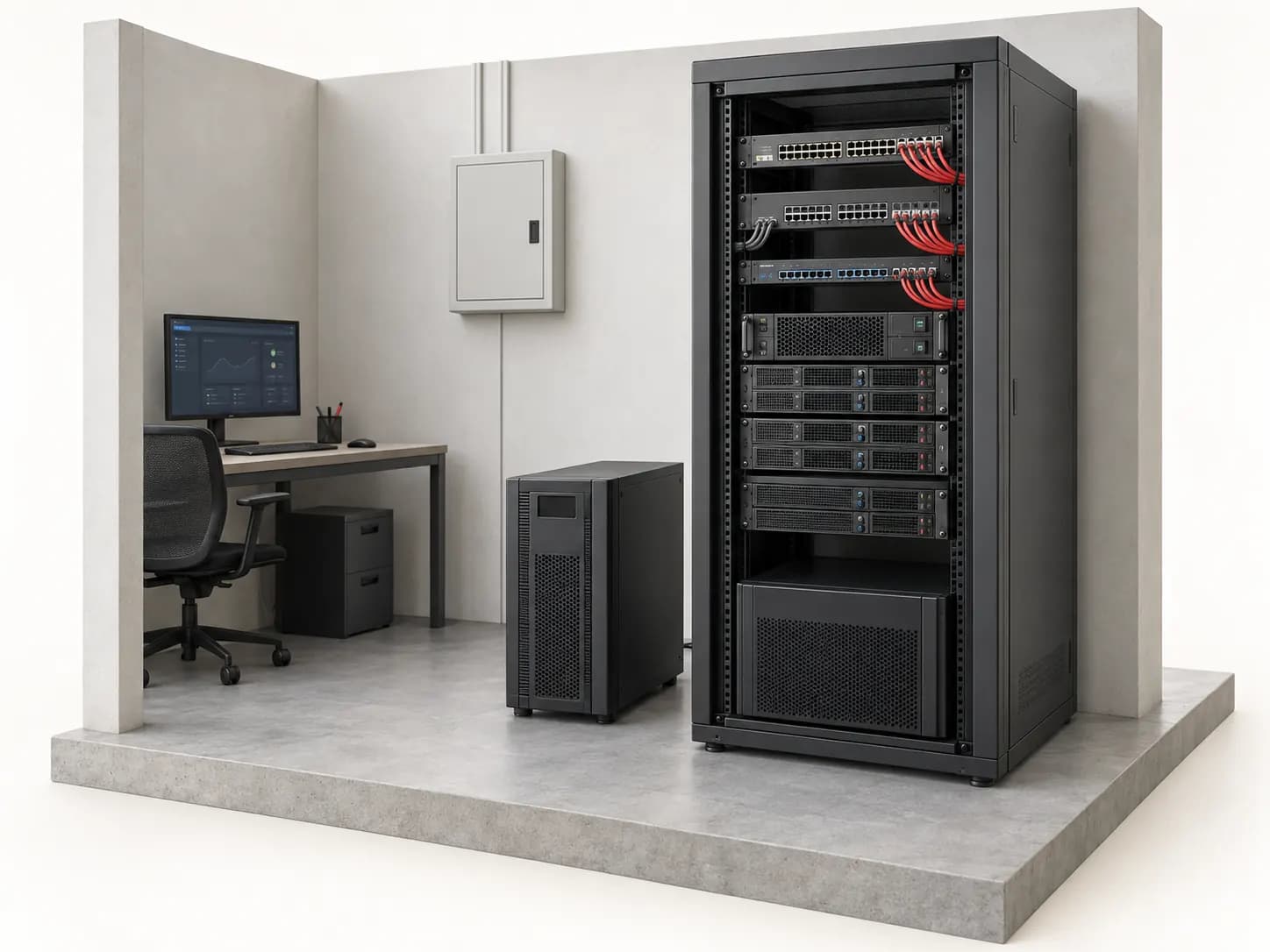
Concept simulation · no equipment connected
Simulate an outage. Follow the supply.
Mains power supplies the devices. The presence of a UPS does not, by itself, confirm service status.
Assumptions: an available, charged and correctly sized UPS; compatible PoE equipment. No runtime is calculated. Powered equipment does not prove operator access, correct configuration or service availability.
03
Five separate decisions to document.
Scroll the table horizontally to compare all three columns.
| Criterion | Project input | Required evidence |
|---|---|---|
| Capacity | Backed-up loads, W and VA, maximum operation and growth. | Model limits and explicit headroom assumptions; neither averages alone nor incompatible figures added together. |
| Runtime | Retained service and required duration at a defined load. | Manufacturer curve or data for the exact model, load and batteries. |
| Topology | Equipment constraints and supply characteristics to address. | A justified choice among documented technologies, without assuming a label resolves every disturbance. |
| Installation space | Rack or floor placement, dimensions, weight, access and environment. | Complete dimensions, supports, ventilation and manufacturer installation conditions. |
| Operation | Who receives alerts and controls any shutdown? | Documented interface support, tested scenario and handed-over access. |
04
Worked example: a small site’s network and recording.
ILLUSTRATIVE EXAMPLE
Fictional input values for four devices, chosen only to explain the calculation. They come from no catalogue reference and are not measurements of your site.
Define the loads
Switch including its PoE loads: 90 W / 120 VA; recorder: 50 W / 60 VA; router: 15 W / 20 VA; provider optical terminal: 10 W / 15 VA. The workstation and printer are outside this scope.
Total each unit separately
The example totals 165 W and 215 VA. Do not add PoE cameras again: their load is already included at the switch input. This total describes the selected load, not the final UPS rating to buy; limits and future changes still need assessment.
Request runtime evidence
State the required duration and behaviour before battery depletion. Request the curve for the chosen load and configuration, then agree a controlled test. No duration in minutes follows from the VA total alone.
Powering the router and provider terminal does not guarantee external-network availability. This example is neither a service-continuity promise nor an electrical test procedure.
05
Six inputs to provide for a quotation.
Which service must stay available?
Name priority functions, dependencies and what can stop. Record hours and the person approving priorities.
Which documented loads?
Per-device table: reference, quantity, available W/VA, value source and operating mode. Flag unknowns and avoid PoE double counting.
What duration and end behaviour?
Required duration at the selected load, any shutdown and restart conditions. Separate the business need from the result still requiring manufacturer confirmation.
Where will it be installed?
Dimensions, rack or floor, ventilation, room temperature, access and handling constraints. Have accommodation and connection requirements validated.
Which interfaces and accessories?
Connectors, cords, supports and any management card or software. Separate included items, options and licences in the offer.
Who tests and follows up?
Test owner, expected results, documentation and battery follow-up under applicable instructions. Equipment supply does not imply a maintenance contract.
06
Commitments to define, not assume.
A manufacturer curve describes given conditions; it does not replace assessment of actual load, battery condition and environment. State assumptions, included items and outstanding checks in the offer. This page does not cover whole-building backup, life-support medical devices or fire-safety functions: these require their own assessment and responsibilities.
07
Understand the offer before selecting a reference.
Does a higher VA rating always mean more minutes?
No. Capacity and runtime are separate. Compare documented runtime at your load and proposed battery configuration; do not rank units on VA alone.
Should I add cameras and the PoE switch together?
First check what the switch value includes. If it already includes PoE loads, adding them again distorts the total. Otherwise establish complete input consumption using a documented method.
Does a UPS automatically keep Internet available?
No. Identify required local devices and their supplies, plus the provider dependency. Continued local power does not establish external-service availability.
Can batteries be replaced with any similar-looking model?
No. Confirm the replacement reference and manufacturer service conditions. This page gives no procedure: replacement and used-battery handling must follow required instructions and competence.
Are remote management and software shutdown included?
Only if the offer states so. Check cards, interfaces, software, licences and supported systems, then test the scenario. A connector alone does not prove the complete function.
Technical sources
External reading references. These documents explain principles; they do not certify catalogue products or their combination.
- UPS sizing guideEaton · Sources consulted on
- UPS Fundamentals and FAQsEaton · Sources consulted on