
01
Choose what must continue, and for how long.
Start with an observable function: retain local recording, finish a task or shut down cleanly. Name an owner, requested duration and acceptable interruptions for each. “Back up the office” is too vague. Duration is a requirement to assess, not a promise attached to a VA rating.
Then trace dependencies. A powered recorder does not meet the same need if cameras or their powering switch are off. A powered router does not guarantee the Internet provider works. Separate local service, remote service and notification: they may have different continuity conditions.
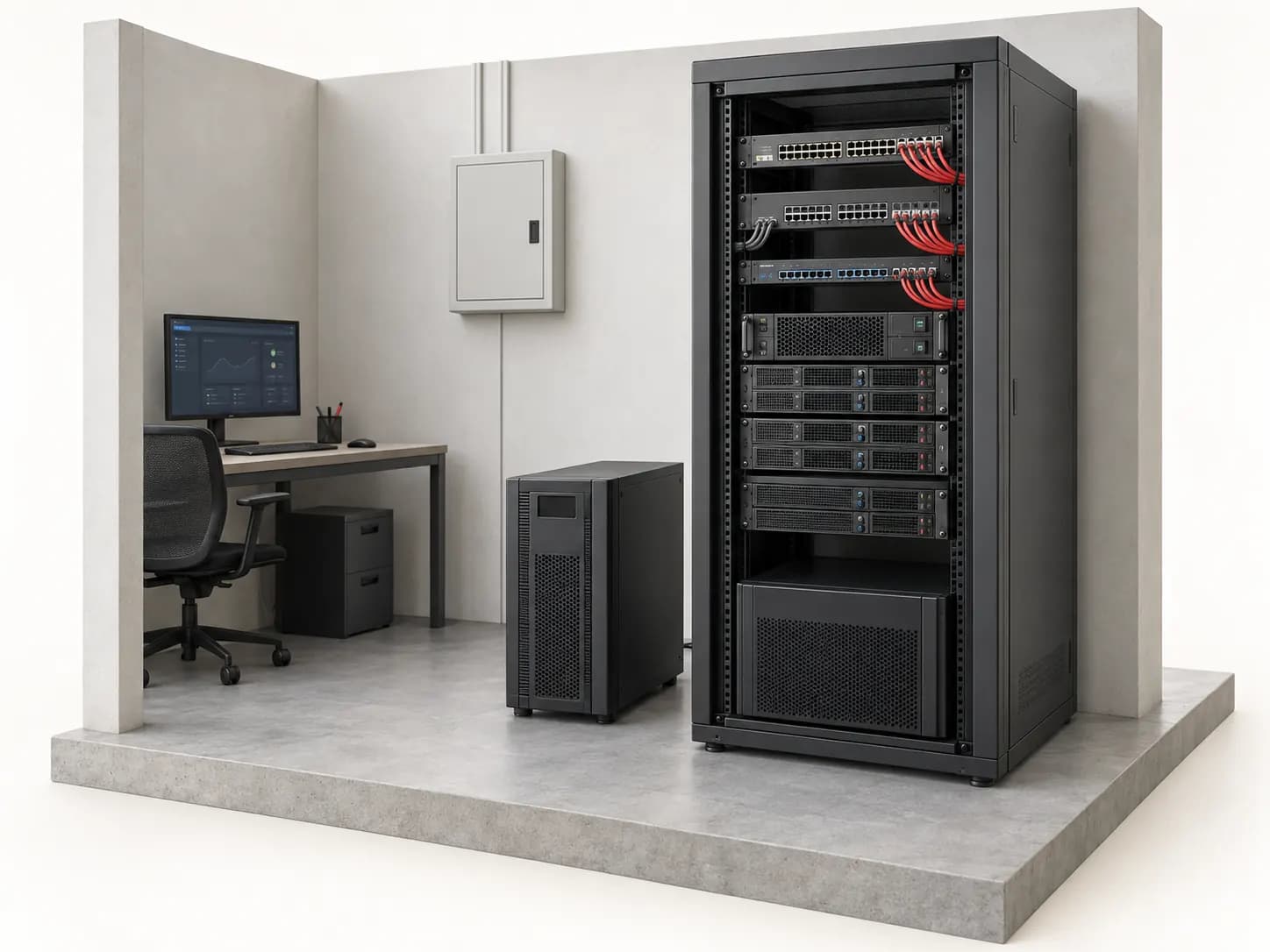
Concept simulation · no equipment connected
Simulate an outage. Follow the supply.
Mains power supplies the devices. The presence of a UPS does not, by itself, confirm service status.
Assumptions: an available, charged and correctly sized UPS; compatible PoE equipment. No runtime is calculated. Powered equipment does not prove operator access, correct configuration or service availability.
02
Four questions, not one capacity figure.
Scroll the table horizontally to compare all three columns.
| Question | Evidence to obtain | Avoid this conclusion |
|---|---|---|
| Real power | Load in W, conditions and evidence, then the model’s W limit. | A higher VA rating does not establish sufficient W capacity. |
| Apparent power | VA load or documented power factor for the stated conditions. | Do not convert every load using an arbitrary factor. |
| Battery runtime | Curve for the exact UPS/battery configuration and assessed load. | VA does not provide a number of minutes. |
| Useful outcome | Authorised check of the complete service and recovery. | A green light proves neither Internet availability nor clean software shutdown. |
03
Create an inventory that can be checked.
One row per actual load
Record model, quantity, function, supply and intended outlet. Distinguish measured power, nameplate data and manufacturer maximum; retain measurement conditions. A power supply’s maximum rating does not necessarily describe normal device consumption.
No PoE double counting
State whether switch mains demand already includes PoE devices. If so, do not add them again at the same UPS input. Conversely, a switch-only figure does not automatically cover endpoints. Mark this boundary in the schedule.
Physical and electrical constraints
Record location, format, access, ventilation, outlets and circuit references. A professional validates voltage, protection, special loads and startup. Do not invent universal reserve or motor/printer suitability from average operation alone.
Battery depletion and mains return
Specify alert recipients, permitted shutdowns and recovery order. Check any required interface, software and licence. Electrical connection alone creates neither controlled application shutdown nor confirmed notification receipt.
04
A coherent chain before any runtime promise.
ILLUSTRATIVE EXAMPLE
Fictional case reused from the continuity dossier: switch including PoE, recorder, router and optical terminal total 165 W and 215 VA. These teaching figures describe no catalogue product.
Check both limits
A fictional 170 W / 200 VA proposal fails: W fits but VA exceeds the limit. A capacity above both totals would still only be a candidate, not proof of outlet, startup or runtime suitability.
Separate expected outcomes
The test plan requires a new local recording during backed-up operation. Remote viewing and notification are checked separately. If the provider link is unavailable, the report must state the limit instead of “everything available”.
Document recovery
After the professionally prepared sequence, check recording recovery, timestamps and actual fault clearance. Sent is not received notification. Confirm duration from the curve and agreed tests; do not turn W/VA totals into minutes.
Written scenario only. Do not interrupt site power to reproduce it. Real tests require authorisation, a safe procedure, backups and operational coordination.
05
Plan operation from the quotation stage.
Selection evidence
Attach inventory, exact model, battery configuration and load-specific curve. Separate requested need, calculated result and measurement. Leave unconfirmed assumptions visible rather than converting them into a commercial commitment.
Ownership and maintenance
Name owners for alarms, batteries and load changes. Retain manuals and model-specific maintenance conditions. Network growth may require reassessment; initial selection does not cover every future extension.
A usable handover sheet
Label backed-up and non-backed-up outlets, contacts and alert procedure. Check behaviour with authorised users. Store sensitive access details through the agreed mechanism, not in a quotation or public rack label.
06
Request a solution against a defined scope.
Provide priority functions, dated load inventory, requested runtime, constraints and unknowns. Inovexia supports documented selection and the supply enquiry. Electrical work, integration and maintenance commitments are agreed separately with competent providers. An equipment quotation is not proof of installation compliance or validated continuity.
07
Clear these uncertainties before selection.
Does a 1,000 VA model run longer than a 700 VA one?
Those figures alone cannot answer it. Compare battery configurations and curves at the same useful load and stated conditions. Output capacity and stored energy are separate questions.
Will the network remain remotely accessible?
Only if the necessary chain, external links and services work. Check local access, remote access and notifications separately; provider backup time is not assumed.
Can the entire rack be backed up for convenience?
Scope follows verified functions and loads. Adding an outlet may add an overlooked device and change the result. Label circuits and validate each change instead of silently expanding the load.
Does a new battery guarantee continuity?
No. Compatibility, system condition, load, settings and service recovery still need checks. Follow the manual and professional scope; do not assume replacement is possible without interruption.
Which unknowns should remain visible?
Unmeasured consumption, missing power factor, battery accessories, startup loads and untested software behaviour. Assign confirmation owners; do not borrow values from a neighbouring model.
Technical sources
External reading references. These documents explain principles; they do not certify catalogue products or their combination.
- UPS sizing guideEaton · Sources consulted on
- UPS Fundamentals and FAQsEaton · Sources consulted on