
Prepare my site brief: worksheet and printable PDF
01
Three documents describing the same installation.
The socket plan locates points in rooms. The patching schedule links each point to a rack termination, active port and purpose. The rack elevation describes equipment positions and envelopes. They complement each other: a polished network diagram does not replace the label needed to find a socket behind a desk.
Assign stable labels before testing. As an illustration, O-01 identifies a room, P-01 a socket, B-01 a panel and S-01 a switch; this is not a universal naming convention. Define the legend and use matching field/report identifiers. Record unreadable or conflicting labels rather than inventing a route.
02
Do not confuse four different capacities.
Scroll the table horizontally to compare all three columns.
| Element | Count or verify | Separate check |
|---|---|---|
| Socket and fixed link | Destination, type, labels and installed-scope test. | An added cord changes the complete channel. |
| Patch panel | Terminated, used and reserved positions. | Its sockets create neither active ports nor PoE. |
| Rack space | Usable height, mounting depth and clearance. | A U count does not prove cable clearance. |
| Physical operation | Weight, support, access, power and ventilation. | Free space is not validated thermal capacity. |
03
Record what determines references and accessories.
Points and routes
Assign each point a use, zone and rack destination. Separate retained, unverified and new links. Record feasible routes, access constraints and environment. Cable category alone does not define connectors, cords and installation conditions.
Patching and active ports
Write an end-to-end row: socket, cable, panel/position, cord, switch/port and role. Count uplinks separately from user sockets. Plan suitable cord lengths and cable management, not one universal length. Passive reserve needs a real active-port path when commissioned.
Rack envelopes
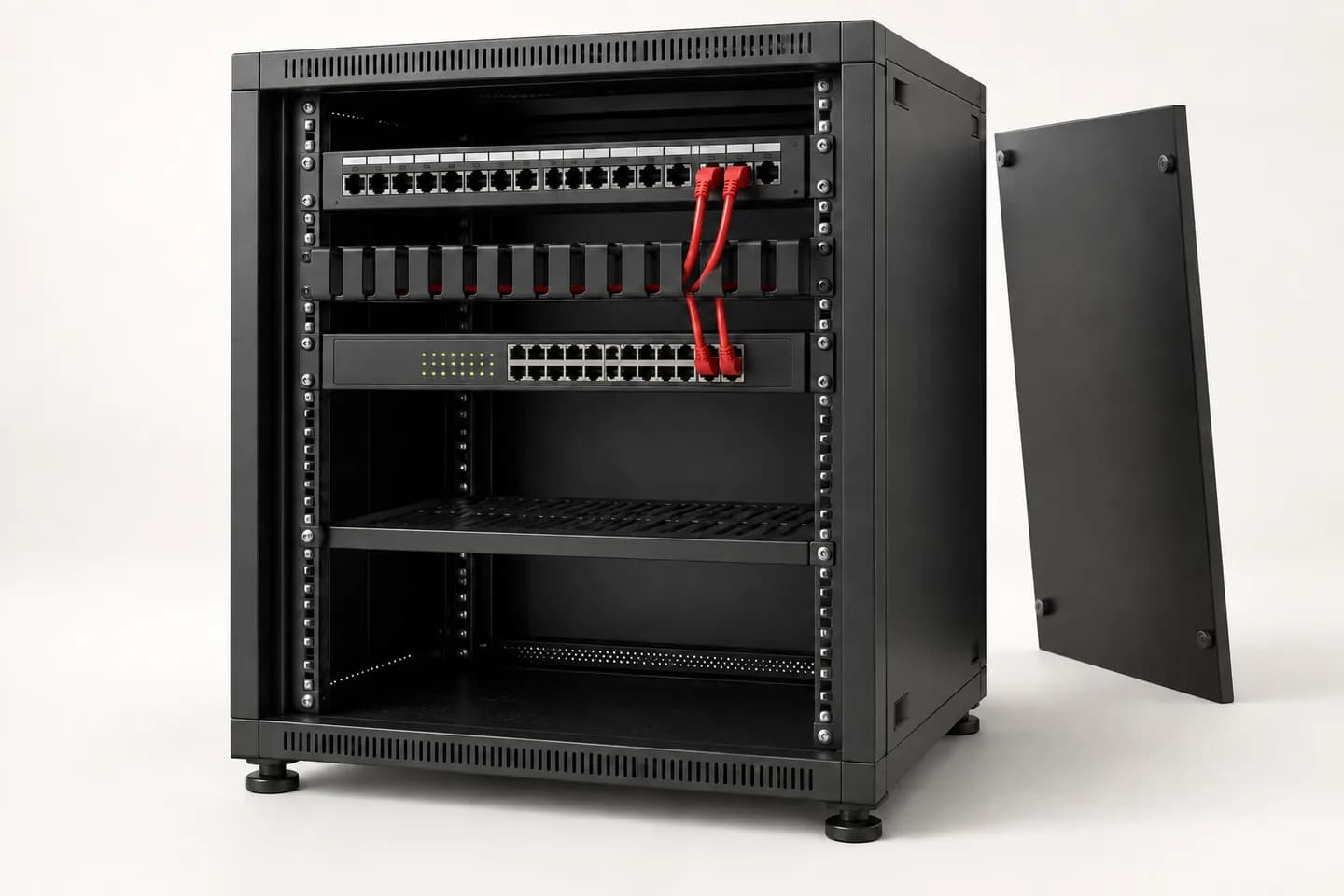
Request each item’s dimensions, weight and supported mounting. Count a shelf together with the height of its contents. Check rails, fixings, usable depth, doors and connectors. A rear power unit or required cable bend can invalidate a choice that fitted the U count.
Access and maintenance
Identify who can open the rack, replace a cord and update the schedule. Competent professionals assess the room, supports and electrical installation. Require a practical replacement path and justified reserves; an arbitrary empty row is not a universal cooling rule.
04
Two missing units are enough to reject a proposal.
ILLUSTRATIVE EXAMPLE
Fictional case: panels 2 U, cable managers 2 U, switch 1 U, router 1 U, shelf with equipment 3 U and UPS 2 U. Named expansion reserves another 3 U. These envelopes are not real product dimensions.
Count envelopes once
Occupation is 11 U and planned demand 14 U. A 12 U proposal lacks 2 U and fails while expansion remains in scope. Do not count the contents already included in the shelf’s 3 U twice or remove reserve without a scope decision.
Move from height to actual fit
An 18 U proposal leaves 4 unallocated units after planned demand. It is not yet approved: UPS depth, rails, supported weight and clearance are unknown. Await dimensional drawings and layout validation; four empty boxes do not prove fit.
Match the report to the correct link
The fictional O-01/P-01 socket reaches B-01/05 then S-01/09. If the report covers B-01/06, the intended link is not evidenced even if it says PASS. Correct the association or obtain the right test; never rename a result to hide missing evidence.
Preparation example only. No drilling template, load rating, electrical separation distance or installation compliance is prescribed.
05
Define expected evidence before work begins.
Cabling scope
The permanent link is the fixed part; the complete channel includes relevant cords. State configuration and test criteria. Continuity alone is not transmission-performance certification. A channel report must not be presented as testing a different permanent link.
Result traceability
Each result retains link ID, date, method, parameters and exceptions. Agree readable reports and useful original files. A green-light photo or aggregate pass count cannot retrieve the history of one socket.
Service and final record
After cabling tests, verify intended uses on activated ports with owner authorisation. Update actual patching and label inactive sockets. Future work should not require random disconnection: deliver plan, schedule, elevation, results and update responsibility.
06
Quote an infrastructure, not merely a cable list.
Provide points by room, known routes, terminations, rack equipment and scope boundaries. Separate supply, installation, testing and documentation; state remaining surveys. Inovexia prepares documented references/accessories. Agree site validation, permissions and acceptance with competent professionals. Keep sensitive plans and network secrets out of an open commercial enquiry.
07
Clarify quotation and handover items.
Does a 19-inch rack guarantee everything fits?
No. Check usable height, depth, rails, connectors, weight and clearance. Mounting width does not determine cable space or maintenance access.
Do 24 panel sockets mean 24 active connections?
No. Links, cords, active ports and configuration are also needed. Distinguish each state. A free panel position proves neither network nor power capacity.
Is continuity testing enough for cabling acceptance?
It depends on agreed scope, but it does not prove every performance requirement. Name method and criteria. Do not call a conductor-wiring check certification of transmission performance.
Must one unit be left empty between every device?
There is no universal rule. Follow manuals, airflow and the overall thermal assessment. Expansion reserve and functional clearance are different needs to justify.
What if labels and reports do not match?
Keep the discrepancy visible and have an authorised person verify the link. Correcting a label does not authorise assigning results to an untested cable. Close the exception with traceable evidence.
Technical sources
External reading references. These documents explain principles; they do not certify catalogue products or their combination.
- Cabling Mistakes — Channel Testing and Permanent LinksFluke Networks · Sources consulted on
- Document Cabling Certification with LinkWare PC and LinkWareLiveFluke Networks · Sources consulted on
- Demystifying Fiber Test Methods — Back to BasicsFluke Networks · Sources consulted on
- Maximum equipment and cable mounting depth for NetShelter WXSchneider Electric · Sources consulted on